


 Be First to Apply
 Be First to Apply


Army Officers
- Posted 1d ago
- On Site
- Full Time
 Posted 1d ago
 On Site
 Full Time


Job Description
Roles are filling up - Apply now!
Military Role
Initial Induction Training 27/1, starts 11 Jan 2027
This role requires strategic thinking, decisive leadership, and the ability to adapt under pressure. You will develop strong problem-solving abilities and foster a commitment to service while prioritising the welfare of those under your command. Whether involved in military operations, supporting humanitarian missions or conducting preparedness training in camp, you will strive to make a positive impact both domestically and internationally, embodying the Army’s core values of courage, comradeship, commitment, and integrity. The Army Officer role offers an accelerated pathway to leadership, where candidates are selected based on potential rather than experience. It is important to note that good leadership can be delivered in different ways and with different styles - you can succeed as an Army Officer if you are genuine, authentic, and motivated to learn with a growth mind-set.
Basics
Must be 18 years old by the time you graduate from recruit course.
Eligible to meet national security clearance criteria, as stipulated by the Government's Protective Security Requirements.
Pass an Officer Selection Board.
While we accept school leavers, we would prefer people who may have a bit of life experience and possibly some tertiary education. Some scholarship opportunities exist for school leavers who have achieved a good education and are interested in tertiary study. All Officers will have the opportunity to pursue further study as you progress through your career.
Education
NCEA Level 2 certificate
Find out more about the NCEA levels and certificate requirements
Fitness & Medical
You must be medically fit for service.
You must meet the minimum entry fitness standards.
Citizenship
There are strict citizenship and security requirements to gain the required SV security clearance for this trade.
Find out if you’re eligible here.
Period of Service
Upon enlistment you are given an offer of service of 15 years. This is the standard Army offer but does not oblige either yourself or the Army to complete this. It is subject to factors including your right to cease service with 3 months notice once your initial training is complete.
Initial Induction Training (IIT)
IIT compresses the recruit ‘basic’ training package completed by soldier recruits into a more intensive 10-week period. The environment is as you would expect: living in shared accommodations with ten others, limited free time, long training days, and restricted access to personal devices. During IIT, you will be trained in a variety of essential areas, including:
Compliance Briefs
Sizing and issue of equipment
Attestation and induction into Ngāti Tū and the NZ Army Marae
Army ethos, values & Warrior Culture
Army Combative Programme (hand-to-hand combat, disarming techniques)
Day and night navigation
Weapons training (MARS-L assault rifle, pistol, grenade, light support weapon)
Field exercises (tactical operations and fieldcraft)
Parade and drill
Self-leadership
Upon completing IIT, you will participate in an "Onwards Day" parade, where your family may attend and witness your transition into the New Zealand Commissioning Course (NZCC).
New Zealand Commissioning Course (NZCC)
Following IIT, you will receive a leave period before moving into new barracks with enhanced facilities, including your own room, access to lounges, kitchens, and social areas and your own bar. The NZCC shifts the focus from individual technical skills to leadership development, teaching you how to command troops across various environments and scenarios. The course begins with classroom-based learning, where you will develop the ability to analyse missions, considering terrain, weather, enemy capabilities, and other factors. You will then learn to deliver detailed orders, ensuring your team knows what to do, how to do it, and why it must be done.
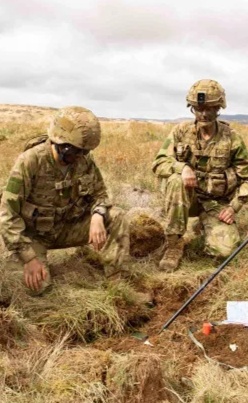
Leadership theory, tactics, and the delivery of orders will be put into practice through field exercises, where you will be tasked with leading troops under demanding physical and mental conditions. Early exercises are designed to be simple, where you will command a small team of around 10 soldiers, but as the year progresses, the complexity increases. By the end of training, you will command larger teams (up to 45 soldiers) and additional assets such as Light Armoured Vehicles or Engineers, in more complex missions.
Field exercises are designed to challenge you across three main lines of effort:
Environment and Climate – Training in diverse conditions such as the subalpine terrain of Waiouru, tropical climates in Fiji, Brunei, or Papua New Guinea, and urban settings in New Zealand, each requiring unique leadership approaches.
Team Size and Resources – As you progress, you will command larger groups and additional resources, necessitating more precise and adaptable leadership.
Mission Complexity – Initially, missions will be simple, but as your skills grow, the complexity of your orders and the scenarios you face (e.g., sudden attacks or equipment malfunctions) will increase.
Throughout these exercises, your leadership will be assessed against key competencies from our leadership framework. You will undergo introductions, formative and summative assessments for three leadership levels: Lead Self (personal leadership), Lead Teams (small teams), and Lead Leaders (up to 40 personnel).
Additional Training and Assessment
In addition to field exercises and leadership development, you will be assessed in the following areas:
Tactics – Classroom-based Tactical Exercises Without Troops (TEWT) that prepare you for field operations.
Military Education – Training in Army administration and welfare responsibilities, including completing a university paper through Massey University.
Regimental Skills – Evaluation of your performance in garrison, managing parades, planning training, and performing general platoon duties.
Benefits & allowances
Earn a competitive salary while training or learning your trade, along with additional allowances for time spent in the field, at sea, overseas, or deployed on operations.
In addition to salary and allowances, other benefits of joining the New Zealand Defence Force include:
- Access to your Service marae or tūrangawaewae
- Sponsored tertiary study programmes at all levels
- Free access to gyms and swimming pools on camp and bases
- Opportunities to travel
- Free and subsidised medical and dental care
- Subsidised food and accommodation on camps and bases
- Subsidised insurance cover
Benefits & Perks
- 📈Professional Development
Company Video
Check if you're eligible to work in New Zealand before you apply - it's fast and free.
Get Your Free Visa Eligibility Check
 Share This Job
 Report This Job